

Segment CDP Implementation
Every tool your client uses needs the same customer data. Right now, they're probably sending it separately to each one.
Here's how most marketing stacks work in practice. The developer adds the GA4 snippet. Then the Meta pixel. Then the Amplitude SDK. Then HubSpot tracking. Then Intercom. Each one is a separate implementation, maintained separately, tracking events with slightly different names and properties, drifting apart every time someone updates one but not the others.
When a client wants to add a new tool, it's another implementation. When they want to remove one, the old code sits there doing nothing. When the data in GA4 doesn't match what's in Amplitude, nobody knows which one is right. And when a user interacts with the product across web, mobile, and email, nobody has a complete picture of what that user actually did.
Segment fixes this at the foundation. You instrument once, and Segment routes that data to every tool in the stack. Add a destination, connect it in Segment. Remove a tool, disconnect it. The tracking code on the site or app doesn't change. The event schema stays consistent. Every downstream tool gets the same data from the same source.
For agencies managing clients with complex MarTech stacks, it's the difference between a data infrastructure that compounds and one that just accumulates technical debt.
What we set up for you
Tracking Plan and Event Schema Design
A Segment implementation is only as good as the tracking plan behind it. This is where most implementations go wrong: someone connects Segment and starts sending events without a consistent schema, and within a few months, the data going into every downstream tool is inconsistent and unreliable.
We design the tracking plan before any implementation work starts. Which events matter for the client's business. How they're named. What properties each event carries. How users and anonymous visitors are identified. How the schema maps to the reporting questions the client needs to answer. This document becomes the source of truth for everything that follows and the reference point for anyone who touches the tracking setup later.
Connections: Data Collection and Pipeline Setup
Segment's Connections product is the core data pipeline. We implement the tracking across every source the client has: website, web app, mobile app, server-side events, and third-party SaaS tools. A single, consistent implementation collects events from all of them and routes them to every connected destination.
We handle the source setup for each platform, configure the appropriate Segment libraries and SDKs, and verify that events are arriving correctly before routing them anywhere. Getting the collection layer right first means every destination downstream gets clean data from day one.
Protocols: Data Governance and Quality
Without governance, Segment becomes a fast way to spread inconsistent data across a lot of tools simultaneously. Protocols is Segment's schema enforcement layer. We use it to define exactly which events and properties are valid, enforce naming conventions, block or flag events that don't conform to the tracking plan, and surface data quality issues before they reach downstream destinations.
For agencies managing multiple client accounts, Protocols is what keeps data quality from drifting over time as sites get updated, new features ship, and different teams touch the tracking setup.
Destinations: Routing Data to Every Tool
This is where Segment's value becomes concrete. Once events are flowing through Segment correctly, connecting a new destination is a configuration task rather than a development task. We connect and configure every tool in the client's stack: GA4, Amplitude, Mixpanel, Heap, HubSpot, Salesforce, Intercom, customer support tools, ad platforms, email platforms, and data warehouses.
Each destination gets configured correctly, not just connected. That means mapping the right events to the right destination-specific actions, setting up filters so each tool only receives the events it needs, and verifying that data arriving in each destination matches what was collected.
We also connect ad platform destinations: Google Ads, Meta, TikTok, LinkedIn. When conversion events flow through Segment to these platforms, ad algorithms get consistent, structured first-party data rather than whatever each platform's native pixel managed to collect.
Unify: Identity Resolution and Customer Profiles
A user visits the website anonymously, then creates an account, then uses the mobile app, then calls support. Without identity resolution, those are four separate user records. With Segment's Unify, they're one profile with a complete history of every interaction across every touchpoint.
We configure Unify to resolve identities correctly across the client's sources, merge anonymous and identified user histories, and build unified customer profiles that reflect the full journey. These profiles become the foundation for audience building, personalization, and any marketing activation that depends on knowing who a customer actually is.
Engage: Audience Building and Journey Orchestration
With clean, identity-resolved profiles in Segment, audiences become far more precise than what any single platform can build on its own. We configure Segment Engage to build audiences based on behavioral data, profile attributes, and event history across all sources combined.
These audiences can sync in real time to ad platforms, email tools, and CRMs. A user who completed onboarding but hasn't activated a key feature can be in a targeted email sequence and excluded from acquisition campaigns simultaneously. A high-value customer who hasn't purchased in 90 days can appear in a win-back campaign across Meta and email at the same time. The data is in one place, the audience is defined once, and every tool acts on it.
Reverse ETL and Warehouse Sync
For clients with an existing data warehouse, Segment connects in both directions. Event data flows into the warehouse for storage and analysis. Data from the warehouse flows back into operational tools through Reverse ETL so CRM records, customer attributes, and derived metrics stay current without manual exports.
We configure warehouse destinations for BigQuery, Snowflake, Redshift, or the client's existing warehouse, and set up Reverse ETL jobs to sync the data that needs to flow back into tools like Salesforce, HubSpot, or Intercom.
Server-Side Event Collection
Client-side tracking through Segment has the same limitations as any browser-based implementation: ad blockers, browser privacy settings, and network interruptions all create gaps. For conversion-critical events, we implement server-side sources that send events directly from the client's application server through Segment to all connected destinations.
Server-side events are more reliable, harder to block, and carry richer data because they have access to server-level information the browser never sees. For purchase events, account creations, and other high-value actions, server-side collection through Segment is significantly more accurate than browser-based tracking alone.
Consent Management Integration
We integrate Segment with the client's consent management platform so tracking respects user consent signals correctly. Events only route to destinations the user has consented to. When consent is withdrawn, data stops flowing to the relevant tools. The implementation is documented so it's auditable for GDPR and similar compliance requirements.
What actually changes when Segment is the data layer
The immediate change is consistency. Every tool in the stack gets the same events, named the same way, with the same properties. When GA4 and Amplitude report different numbers, the discrepancy is now a configuration question rather than a fundamental data quality problem.
The longer-term change is speed. When a client wants to add a new analytics tool, test a new email platform, or connect a new ad platform, the tracking work is already done. Connect it in Segment, map the events, go live. What used to be a development project becomes an afternoon of configuration.
For agencies, that speed is a service advantage. You can move faster on client stack changes without engineering bottlenecks, and you can make data quality promises that actually hold up.
Where Segment fits in a broader analytics stack
Segment is not an analytics platform. It doesn't replace GA4, Amplitude, PostHog, or any of the tools that clients use to analyze data. It's the layer between data collection and those tools that makes all of them work better with less maintenance.
For clients already running multiple analytics and marketing tools with separate tracking implementations, Segment consolidates that into something manageable. For clients building out a new stack, implementing Segment first means never having to re-instrument from scratch when they add a tool.
SmartMetrics implements Segment as part of broader analytics engagements or as a standalone infrastructure project. If you're already using us for GA4, server-side tracking, or analytics platform setup, Segment fits directly into that work as the data layer underneath everything else.
What clients say
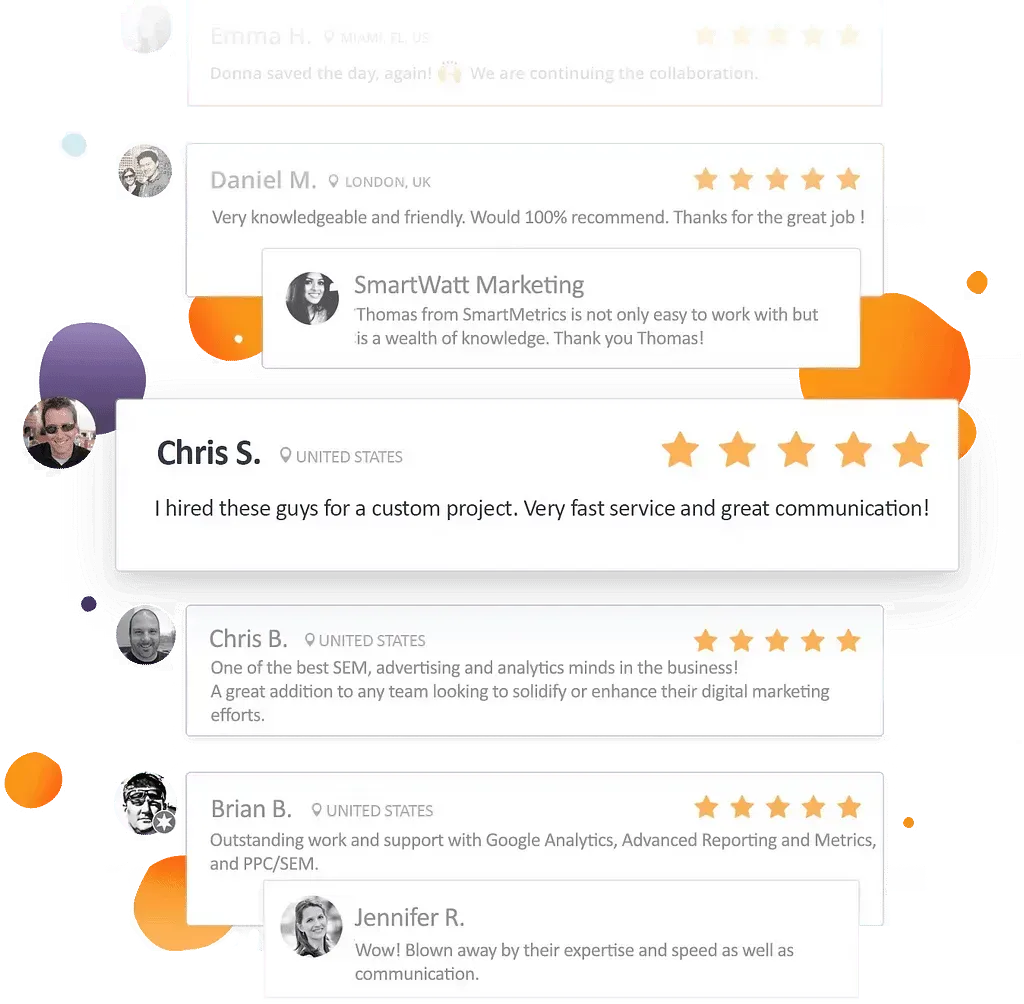
“Wow! Blown away by their expertise and speed as well as communication. We had a botched Google tagging job that needed to be fixed and they jumped right in and had it done in the same day. I'm recommending them to everyone I know needing help with the Google suite of business tools.”
Jennifer Roberge
“Tomas is amazing! I had no idea how to get anything set up and I had a million questions. He answered all of my questions and was super patient with me. He is very knowledgeable and very good at what he does, I would highly recommend Smartmetrics and Tomas if you have any google advertising needs.”
Lavinia Lobo
Smartmetrics
“Finding SmartMetrics was a real relief – as a research and education institute with a somewhat unconventional focus within Google Analytics, we previously struggled to find an online training program or consultant that could help us. SmartMetrics helped us to review our entire GA4 setup, and finalized multiple dashboards that addressed our subdomain website complications and redesigned our PDF download tracking. Tomas was clear, communicative and efficient, and took time to provide helpful advice at every stage of the project. We would definitely choose SmartMetrics again for future GA4 improvements.”
Micah Greyeyes
Yellowhead
What clients say
“Tomas at SmartMetrics has been fantastic to work with. He consistently delivers high-quality work quickly, communicates clearly and proactively, and makes even complex implementations feel straightforward.”
 Gray Digital Group
 5.0 on Google · All reviews
“A huge difference to the business, and we know where the next dollar goes.”
 Blitzy
“We can scale spend now without guessing what is actually working.”
 PermitFlow
“Extremely knowledgable & capable!”
 Dj Haer Jr


Work with Tomas
Founder, San Diego, CA
20 years in marketing, CRO, CRM, and analytics. Now building the systems AI runs on.
You work with me directly, from scope to delivery. No account managers.