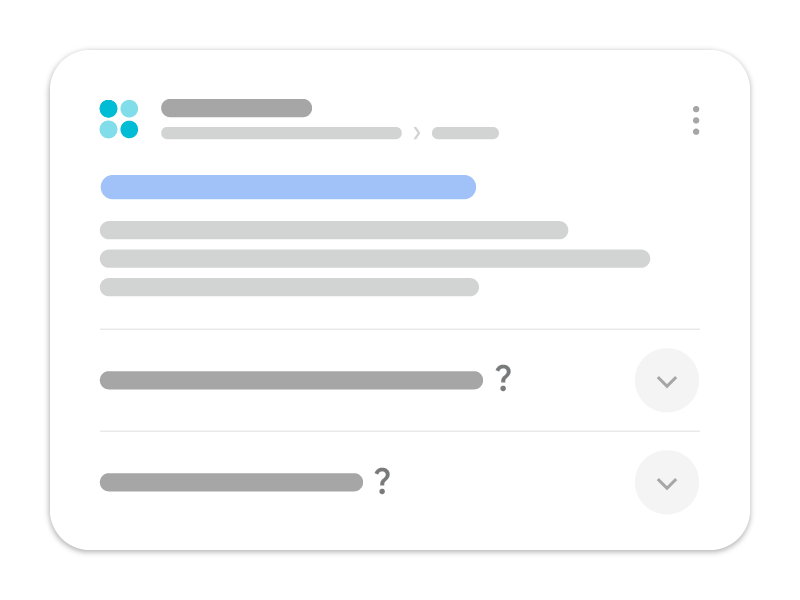

May 7 was the cutoff in search, the report drops out of Search Console in June, and the Search Console API stops supporting the FAQ rich result type in August. If you've spent any time on LinkedIn in the last few days, the reaction has been louder than the actual news warrants. The FAQPage schema hasn't done much for commercial sites since 2023, when Google quietly limited the rich result to government and authoritative health domains. Most of the sites adding it for the past three years were getting nothing back from it. This announcement is just the formal cleanup.

Run the test before you panic
A useful test before reacting to anything Google deprecates is to ask whether you were actually getting the rich result in the first place. Open Search Console, look at the FAQ rich result report while it still exists, and check the impressions and click data. For the vast majority of agencies, the honest answer is somewhere between "barely" and "no." That means the deprecation doesn't change anything except the cleanup work of pulling unused markup off pages, and even that is optional. The schema doesn't hurt anything sitting on a page. It just doesn't do anything either.
Ranking-wise, nothing moves. The FAQ schema was never a ranking signal, and Google has been pretty consistent on this. It was an eligibility flag for a visual feature, and the feature got cut. Pages don't lose anything when Google stops reading an eligibility flag, because eligibility flags weren't doing the ranking work to begin with. Anyone telling you to brace for a ranking impact is either confused about how schema works or selling a fix to a problem that doesn't exist.
PAA never ran on schema
Schema doesn't power People Also Ask features, and it never did. PAA runs on the model's read of the body content, which means an H2 like "Does Klaviyo work with Shopify Plus" with a direct one-sentence answer on the next line tends to land in PAA, whether you have FAQPage markup or not. The pages that don't land in PAA usually have one of two problems. Either the question phrasing in the heading doesn't match how anyone actually searches, or the page buries the answer under three sentences of brand setup before getting to the point. Both of those are content fixes, not markup fixes.
Schema still worth keeping
The schema types still earning real visibility are the ones that produce rich results, which Google still actually shows. Product markup gets you the merchant carousels and price displays. LocalBusiness drives the local pack and map placements. Organization helps shape knowledge panels for brands with enough search volume to trigger one in the first place. Event, Recipe, and HowTo all still produce visible SERP treatments for the right kind of site. The list is shorter than it was three years ago, and the FAQ page is no longer on it. Saying that out loud to clients who've been paying for FAQ schema implementation is uncomfortable but worth doing.
The AI search claim that's about to spread
The AI angle is where most of the bad advice will come from over the next few weeks. There's a claim circulating that even when Google stops using a schema type, you should keep adding it for LLM visibility, because structured data is more machine-readable and helps language models understand a page. The claim is mostly wrong, and it's been mostly wrong for a while. LLMs read pages the way crawlers do, by processing rendered text. Schema markup sits in the page source, but it doesn't survive tokenization in any meaningful way. A clean H2 followed by a direct answer is more useful to a language model than the same content wrapped in JSON-LD, because the model reads the words and the document structure, not the markup vocabulary.
Getting cited in AI Overviews, ChatGPT, Perplexity, or any other answer engine works on the same principle as PAA. The model wants a question and an answer it can quote. If your page has the question in a heading and the answer as the very first sentence after that heading, you become quotable. If your answer sits behind a paragraph of brand introduction, you don't. Most agency content tries to hold attention through the page, which means it stalls before delivering the answer. Stalling kills both PAA and AI citation. Strip out the throat-clearing and put the answer in the first sentence after the question. That single change does more for AI visibility than any markup decision you'll make this year.
What's next?
What this really comes down to now is maintenance, not expansion. If a site already has FAQ schema implemented cleanly and it isn't creating problems, there's usually no urgent reason to rip it out. But adding new FAQ markup purely for SEO value no longer makes much sense now that Google rarely surfaces the visual treatments that once justified the effort. The smarter move is to audit existing implementations, remove bloated or low-value FAQ sections that exist only for markup coverage, and focus instead on pages that answer questions quickly, clearly, and high enough on the page for users to find without friction. In most cases, improving the content itself will produce more durable results than expanding schema coverage ever did.


 Gray Digital Group
 Blitzy
 PermitFlow
 Dj Haer Jr