
Your RevOps dashboard goes red. ARR dips. Win rate softens. Forecast variance widens.
You already knew something was off. The board chart confirms it. What it still will not tell you is what broke, which record started it, or how long the damage sat there.
By the time a metric turns red, money and trust have already left the building. Tracing the mess across CRM, warehouse, and billing eats the week. That is the real tax.
Dashboards lag. Archaeology costs more.
Most revenue dashboards show the current state. They are good at "something is wrong." They are weak at "this opportunity amount changed after approval on March 12, and billing never caught up."
So your team does the expensive part by hand. Export CRM. Export billing. Join in a spreadsheet. Guess which integration user overwrote which field. Check whether the warehouse even keeps history, or only today's snapshot.
Spotting the leak is cheap. Proving when and where it started is not. CRM field history ages out. Integration users overwrite each other. Warehouses often hold current state, not a point-in-time copy of money objects. You feel that as weekly manual audits, half-day edge cases, and a slow tax on ops time. Forecast credibility takes the hit next.
Industry coverage of CRM hygiene and CRM-to-finance gaps keeps landing on the same idea. Leak often hides in mismatched deal values, missing billing links, and closed-won records that never become invoices. Forecast miss is frequently the first public sign, not the root cause.
Three leaks that look like "ops noise"
These are fictional but familiar. None of them need a dramatic outage. They need a missing check.
1. The discount that walked back after approval
A mid-market SaaS deal clears discount review at 12%. Two weeks later the opportunity amount is lower. Nobody filed a new approval. An AE "cleaned up" line items before close. Finance books the approved number. Billing ships the lower one. The gap is $4,800 a year on one account. Multiply by a dozen quiet edits and your ARR board story starts lying.
Your dashboard may still show a healthy closed-won total. The leak lives in the gap between approved amount and billed amount.
2. Closed-won with no invoice
A services firm marks eight deals closed-won after verbal yes. The CRM celebrates. The billing queue never gets a complete handoff for two of them. One sits because a PO field is blank. One sits because the sync user failed overnight and nobody owns the exception list.
Sales thinks the quarter is fine. Cash does not arrive. A month later someone runs a one-off match and finds $61k that was never invoiced. Recoverable, but late, and hard to explain in a QBR.
Closed-won is a sales outcome. It is not proof that finance started a transaction.
3. The renewal date that moved itself
A CS manager pushes a renewal date out 45 days so a customer can finish a rollout. The CRM subscription object updates. Billing still invoices on the old cycle. Or the reverse happens: billing changes the date and the CRM forecast still assumes the old month.
Your renewal dashboard looks soft or fat for the wrong reasons. You spend an afternoon proving which system is the source of truth for that customer. By then the forecast for the month is already shared.
Why proving the start is so hard
Four boring constraints show up again and again.
History expires. Native CRM field history is useful until it is not. On Salesforce, standard field history is capped on how many fields you track and how long you keep the trail unless you buy longer archive options. Other CRMs keep property timelines, but retention, coverage, and API access vary by plan. If your dispute is older than the trail, you are guessing.
Integration users blur authorship. Sync accounts, middleware, and admin scripts all write as the same "system" user. You see that amount changed. You do not see which playbook or which Zap did it.
Warehouses show now, not then. Many revenue marts store the latest opportunity, line item, contract, and subscription. They do not store what those objects looked like on the day you closed, approved, or amended. Point-in-time questions hit a wall.
Definitions drift across teams. Sales closes on verbal yes. Finance invoices on PO. Billing recognizes on invoice sent. Until those moments share a rule, every reconciliation produces false comfort and false alarms.
Fix path: boring checks plus history that survives
Do not start with a prettier dashboard. Start with controls that catch stage-to-stage nonsense early, and with copies of money objects that you can rewind.
Keep versioned point-in-time copies of money objects
Decide which objects are money. For most B2B stacks that means opportunity, line items, contract or quote, subscription, and amendments. Snapshot them on meaningful events: stage change to closed-won, approval event, contract signature, amendment, cancellation, and billing create or update.
Store enough to answer "what did this look like on date X?" Amounts, discounts, seats, term dates, owners, and the IDs that link CRM to billing. Current-state warehouses alone will not get you there.
Run reconciliation checks between stages
Automate a short list of boring exceptions. Review them on a weekly cadence, not once a quarter.
- Closed-won with no billing record (or no invoice ID) within N days.
- Amount or discount changed after approval or after close.
- Renewal or term end date moved without a matching billing change (or the reverse).
- Expansion or mid-cycle change in billing with no CRM opportunity or amendment within a short window.
- Active customer in CRM with failed payment or cancel in billing.
- Invoice total outside an approved variance of the deal total after tax and proration rules.
Assign each exception an owner. RevOps routes. Finance owns revenue definitions. Sales or CS fixes the record. Track time-to-clear, not just ticket volume.
Make closed-won earn its status
Block or warn on closed-won when billing fields are empty, when discount exceeds the approved band, or when required contract IDs are missing. Soft warnings beat hard blocks if your sales cycle needs flexibility. Either way, stop treating closed-won as a vanity checkbox.
Align the words before you align the charts
Write one page that defines bookings, ARR, closed-won, invoiced, and recognized. Put the source system for each. Share it with sales, finance, and whoever owns the warehouse. Reconciliation fails when teams argue vocabulary instead of records.
What good looks like after 90 days
You still have dashboards. They just stop being the only alarm.
Exception queues shrink because the same five checks fire every week. Forecast meetings argue fewer "why don't these two numbers match" digs. When something does slip, you pull a point-in-time copy instead of reconstructing history from chat and memory.
Teams that treat forecast accuracy as an operating system problem (clean stages, governed fields, CRM-to-billing match) outperform teams that only tune the model. Dirty inputs still beat clever math.
Where SmartMetrics fits
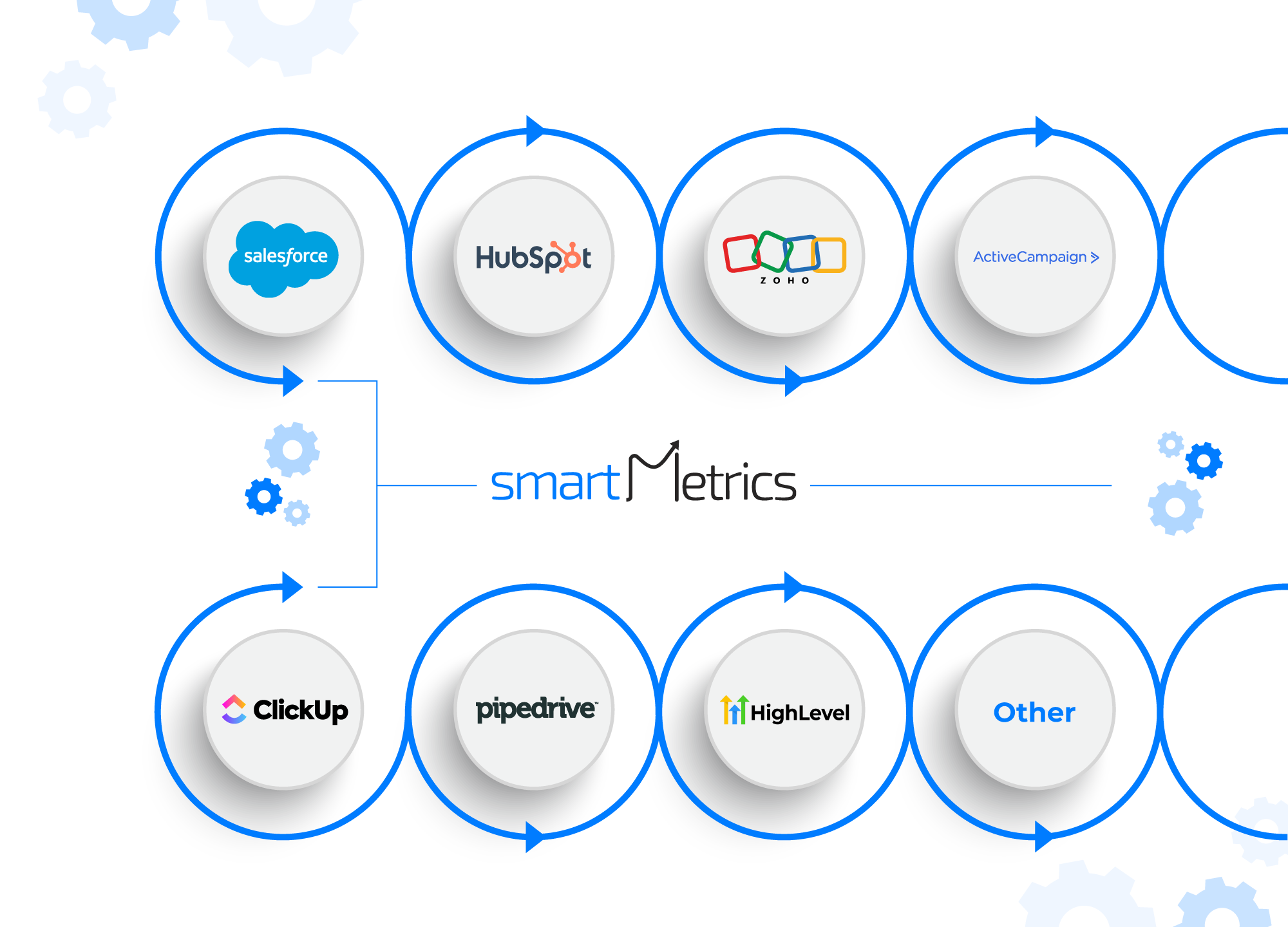
SmartMetrics helps owners and marketing teams keep CRM, tracking, and revenue ops honest. Zoho, HubSpot, Salesforce, Attio, Workiz, and the ads and analytics stack next to them.
If your board chart keeps turning red while nobody can prove when the leak started, start with a CRM and revenue integrity pass. We map where money objects live, which history survives, and which boring reconciliation checks you are missing. You leave with a written order of work you can run with us or in-house.
Send what you run today (CRM, billing, warehouse or BI, and how closed-won becomes an invoice). We will tell you which gaps to close first.





 Gray Digital Group
 Blitzy
 PermitFlow
 Dj Haer Jr