In 2026, advertising monitoring is the backbone of every successful marketing strategy. The rapid evolution of digital channels and data demands a new approach. Are you equipped to track the metrics that matter, from impressions to advanced KPIs? This expert guide breaks down the latest tools, including Looker Studio reports and white-label reporting solutions like SmartMetrics, so your agency or brand can stay ahead. Discover how advertising monitoring empowers you to navigate compliance, optimize campaigns, and outperform the competition with clarity and confidence.
The Evolving Landscape of Advertising Monitoring in 2026
The world of advertising monitoring is undergoing dramatic changes in 2026. Agencies and brands are adapting to a landscape shaped by rapid technological advancements, growing privacy demands, and the need for unified data across countless channels.
Key Industry Shifts and Drivers
Artificial intelligence and machine learning are at the heart of modern advertising monitoring. These technologies boost monitoring speed and accuracy, allowing agencies to spot trends, optimize campaigns, and detect anomalies in real time. The rise of omnichannel marketing means brands now run campaigns across search, social, display, connected TV, and digital out-of-home. This shift demands unified tracking and reporting solutions.
Digital ad spend is booming, with projections reaching $836 billion by 2026. As consumer journeys become more complex, accurate attribution grows in importance. Privacy regulations like GDPR, CCPA, and global equivalents are reshaping how data is collected and used for advertising monitoring. Compliance is no longer a checkbox but a strategic necessity.
Real-time analytics and instant optimization are now industry standards. Major brands have pivoted to real-time ad monitoring, leveraging platforms like Looker Studio to build unified dashboards. These dashboards bring together impressions, reach, frequency, click-through rates, and conversion data for smarter decision-making. Agencies using SmartMetrics benefit from white-label Looker Studio reporting, offering clients branded, automated dashboards that seamlessly integrate cross-channel data.
Top metrics and KPIs have also evolved. Beyond impressions and CTR, agencies track viewability, attention metrics, brand lift, and sentiment analysis. Fraud detection KPIs, such as invalid traffic and click fraud rates, are crucial for campaign integrity. For a deeper look at the trends driving this transformation, see Programmatic Advertising Trends 2026.
New Challenges Facing Agencies and Brands
Despite advances in advertising monitoring, new challenges have emerged. Data fragmentation is a major issue. With campaigns running across social, search, programmatic, and DOOH, stitching together accurate reporting requires sophisticated integration.
Ad fraud is becoming more sophisticated, forcing agencies to adopt advanced detection methods. Monitoring for invalid traffic, bot activity, and inappropriate placements is essential to protect brand reputation. Ensuring brand safety and compliance in fast-moving environments is another growing concern, especially as privacy laws continue to evolve.
Balancing automation with human oversight is critical. While AI-driven tools power much of today's advertising monitoring, expert analysis remains necessary to interpret trends and make strategic decisions. Notably, the industry has seen high-profile fines for non-compliance in 2025, underlining the importance of robust monitoring practices.
Modern solutions like SmartMetrics and Looker Studio help agencies centralize data, automate compliance checks, and maintain transparency. By adopting these tools, brands and agencies can overcome fragmentation, reduce risk, and keep pace with the rapidly changing world of advertising monitoring.
Core Metrics and KPIs for Effective Ad Monitoring
In 2026, advertising monitoring is only as strong as the metrics and KPIs you track. With so many channels and touchpoints, knowing what to measure is essential for optimizing campaigns, proving ROI, and staying ahead of the competition.
Essential Metrics for 2026
Effective advertising monitoring starts with the right metrics. In 2026, agencies and brands rely on a core set of data points to evaluate success across digital and offline channels.
Modern advertising monitoring tools now focus on attention metrics, not just impressions. Viewability is measured by how long an ad is visible, while attention metrics track active engagement. Brand lift and sentiment analysis help marketers understand not just clicks, but how ads change perception.
Fraud detection KPIs are critical. Agencies monitor invalid traffic and click fraud rates using automated systems. Ad verification ensures campaigns appear in safe, relevant environments.
Top agencies use platforms like Looker Studio to unify these KPIs in real-time dashboards. SmartMetrics offers white-label Looker Studio reporting, letting agencies deliver branded, automated insights to clients with ease.
Advanced Attribution and Cross-Platform Reporting
As consumer journeys grow more complex, advertising monitoring must go beyond last-click models. Advanced attribution uses data-driven, AI-powered models to assign value to every touchpoint, whether it’s search, social, display, or connected TV.
Multi-touch attribution is now standard. It tracks how users interact with ads across platforms, connecting the dots between awareness, interest, and conversion. Integrating data from all sources—search, social, display, native, CTV, and DOOH—enables holistic measurement.
Automated, real-time reporting is vital for advertising monitoring. Platforms generate alerts when performance dips or anomalies rise, so teams can respond instantly.
Unified dashboards make reporting easier for stakeholders. Looker Studio is a favorite for custom views tailored to C-suite, clients, or campaign managers. SmartMetrics streamlines this process with white-label solutions, saving agencies time and increasing client satisfaction.
Brands using advanced attribution have seen ROAS increase by up to 30 percent. Automated alerts and cross-platform integration help teams catch issues early and optimize campaigns faster.
For more on marketing analytics solutions that support these efforts, see Advertising analytics and marketing tools.
Best Practices and Tools for Advertising Monitoring
Staying ahead in advertising monitoring is essential for agencies and brands seeking data-driven results in 2026. The right mix of strategy, technology, and process not only boosts campaign performance but also ensures compliance and transparency. Let’s walk through proven steps and tools for mastering advertising monitoring this year.
Step 1: Audit Your Current Monitoring Capabilities
Begin your advertising monitoring journey with a thorough audit of your current tools and data sources. Take inventory of every platform you use, from social media to programmatic and digital out-of-home. Map out where your data lives, who has access, and how information flows between systems.
Identify any gaps in cross-channel visibility or areas where metrics are siloed. For example, an agency might discover that while social ads are well-tracked, programmatic display lacks unified reporting. Before a tech stack audit, many teams miss hidden inefficiencies or duplicated efforts. After a comprehensive review, workflow improvements become clear, leading to better advertising monitoring outcomes.
Quick Audit Checklist:
List all platforms and analytics tools.
Check data integration points.
Assess reporting frequency and accuracy.
Identify manual processes that could be automated.
A regular audit helps ensure your advertising monitoring is agile, scalable, and ready to adapt to new challenges.
Step 2: Select the Right Monitoring Solutions
Choosing the right solutions is crucial for robust advertising monitoring. Evaluate platforms based on scalability, automation, integration capabilities, and compliance features. Leading tools like Google Ads, Meta Business Suite, and Looker Studio offer powerful data aggregation and visualization.
For agencies, white-label reporting is a must. It allows you to present professional, branded dashboards to clients without manual intervention. Consider how each solution supports cross-channel data integration, real-time KPI tracking, and customizable reporting.
PlatformIntegrationAutomationWhite-label ReportingCompliance ToolsGoogle AdsHighModerateLimitedYesMeta Business SuiteHighHighLimitedYesLooker StudioVery HighHighYesYes
By focusing on these criteria, you can build an advertising monitoring system that delivers actionable insights and meets client expectations.
Step 3: Set Up Automated, Real-Time Reporting
Automation is transforming advertising monitoring in 2026. Set up customizable dashboards using Looker Studio to unify data from all your campaigns. Real-time reporting lets you spot trends, performance dips, or anomalies the moment they occur.
Automated alerts can notify you when a campaign underperforms or spends exceed thresholds. For instance, one agency avoided a $50,000 budget waste by catching a spike in invalid clicks through real-time notifications.
Use these steps to streamline reporting:
Integrate all ad platforms with Looker Studio.
Customize dashboards for different stakeholders.
Schedule automated email reports and alerts.
This level of automation ensures your advertising monitoring is proactive and responsive to change.
Step 4: Implement Advanced Fraud Detection and Brand Safety
Protecting your ad spend from fraud and ensuring brand safety are top priorities in advertising monitoring. Integrate AI-powered fraud detection tools and ad verification partners to monitor for invalid traffic, click fraud, and inappropriate placements.
Regularly review key fraud detection KPIs, such as invalid traffic (IVT) rates and ad verification scores. After deploying advanced monitoring tools, agencies have seen significant reductions in IVT, leading to more efficient campaigns and better ROI.
Key practices include:
Setting up automated fraud alerts.
Blocking suspicious sources and domains.
Monitoring for brand safety violations in real time.
By prioritizing these safeguards, you minimize risk and uphold the integrity of your advertising monitoring efforts.
Step 5: Ensure Compliance and Data Privacy
Compliance with evolving privacy laws is a central pillar of advertising monitoring in 2026. Stay updated on regulations like GDPR, CCPA, and global equivalents, and ensure your tools support consent management, audit trails, and data minimization.
Automate compliance checks where possible. For example, agencies that failed to adapt to new privacy requirements in 2025 faced substantial fines. Building compliance into daily workflows, from campaign setup to reporting, helps avoid costly mistakes.
Best practices:
Use platforms with built-in compliance features.
Maintain clear documentation of consent and data usage.
Schedule regular compliance audits and training.
This approach ensures your advertising monitoring remains ethical, transparent, and legally sound.
White-Label Reporting with SmartMetrics
SmartMetrics empowers agencies with fully branded, automated Looker Studio reports for seamless advertising monitoring. The platform streamlines cross-channel data integration, KPI tracking, and professional client communication.
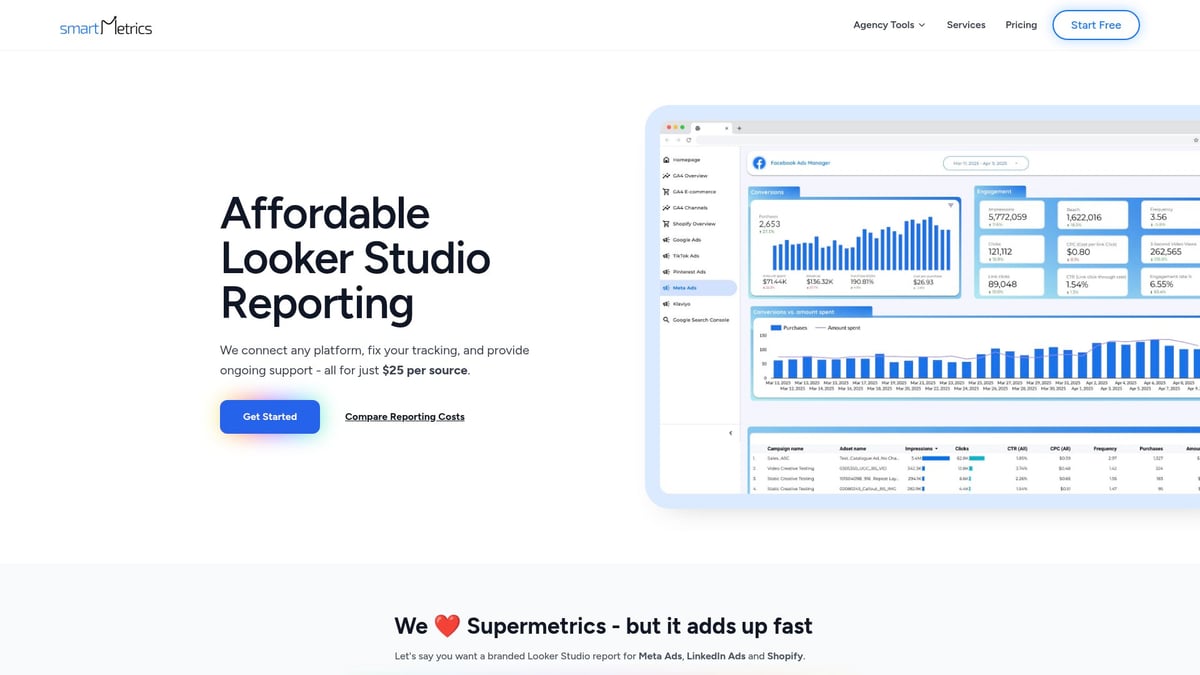
With SmartMetrics, you can run automated audits, centralize performance dashboards, and deliver transparent reporting at scale. Agencies using SmartMetrics save up to 21 days per project cycle, boosting efficiency and client satisfaction.
Discover how White-label Looker Studio reporting can elevate your advertising monitoring with compliance, transparency, and actionable insights - all in one place.
Step-by-Step Guide to Setting Up a Modern Advertising Monitoring System
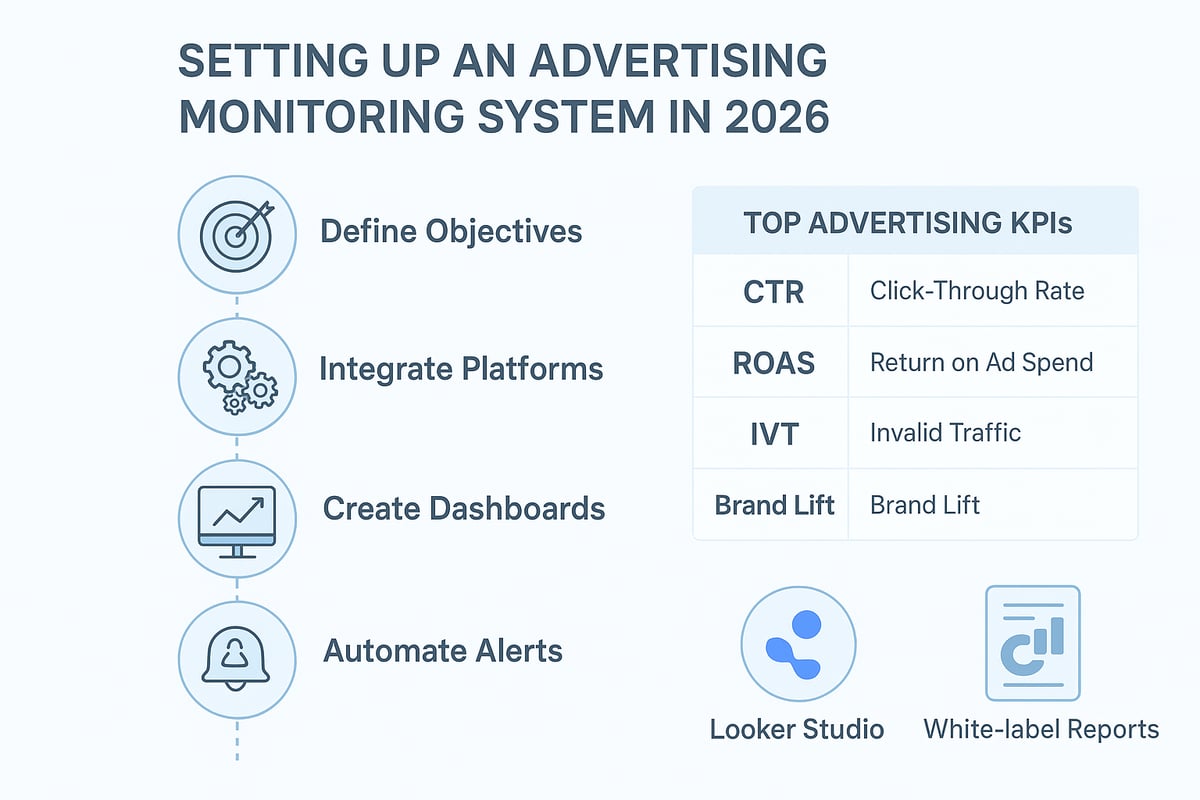
Setting up a modern advertising monitoring system in 2026 requires a strategic, stepwise approach. The right process ensures your campaigns are tracked, optimized, and compliant across every channel. This guide walks you through the essential steps, from goal-setting to real-time optimization, leveraging the latest tools like Looker Studio and SmartMetrics white-label reporting.
Step 1: Define Objectives and Success Metrics
Every successful advertising monitoring strategy starts with clear objectives. Align your campaign goals with broader business outcomes, such as increasing sales, boosting brand awareness, or driving leads.
Next, select the most relevant KPIs for each channel. In 2026, top metrics include impressions, reach, frequency, click-through rate (CTR), engagement rate, cost per acquisition (CPA), return on ad spend (ROAS), viewability, and invalid traffic (IVT).
Step 2: Integrate Data Sources and Platforms
A robust advertising monitoring system depends on seamless data integration. Connect all your ad platforms, analytics tools, and CRM systems to create a unified view of performance.
Start by mapping out your data sources, including search, social, display, CTV, and DOOH. Standardize data formats to enable accurate cross-platform reporting.
Leverage APIs and automated connectors to sync data in real time. This prevents information silos and supports multi-touch attribution, which is critical for understanding the complex consumer journeys of 2026.
By integrating these sources, you ensure your advertising monitoring covers every touchpoint, enabling smarter decisions and more precise optimizations.
Step 3: Build Custom Dashboards and Reports
With integrated data, the next step is visualizing your metrics through custom dashboards. Use tools like Looker Studio to build unified reports that display real-time KPIs across all channels.
Create dashboards tailored to different stakeholders. For executives, focus on high-level trends and ROI. For campaign managers, offer granular views on day-to-day performance.
SmartMetrics takes this further by enabling agencies to deliver branded, automated Looker Studio reports. Their white-label solution streamlines cross-channel data integration and professional client communication, making advertising monitoring both efficient and impressive.
Custom dashboards not only clarify performance but also empower teams to act quickly on insights.
Step 4: Automate Alerts and Optimization Workflows
Timely responses are essential in advertising monitoring. Set up automated alerts to flag performance dips, anomalies, or sudden surges in spend.
For example, use Looker Studio or SmartMetrics to trigger notifications if CTR drops below a threshold or if IVT rises unexpectedly. Integrate these alerts with project management tools to streamline workflows.
Automation ensures your team can react instantly, optimizing campaigns before small issues become costly problems.
Step 5: Monitor, Analyze, and Iterate
Continuous improvement is the backbone of advertising monitoring. Schedule regular performance reviews, using your dashboards to dive deep into trends and anomalies.
Analyze not just what happened, but why. Did a creative change lift engagement? Did a new platform drive better ROAS? Use these insights to refine targeting, creative, and budget allocation.
To ensure compliance and accountability, leverage audit features for ad monitoring. These tools support regular checks, documentation, and transparent reporting, protecting your agency from costly mistakes.
By monitoring, analyzing, and iterating, you create a feedback loop that powers ongoing success in advertising monitoring.
Navigating Compliance, Privacy, and Ethical Considerations in 2026
Navigating compliance, privacy, and ethical considerations is crucial for agencies and brands aiming to succeed with advertising monitoring in 2026. As regulations evolve and consumer expectations shift, mastering these aspects is essential for building trust and sustaining growth.
Evolving Regulatory Landscape
The regulatory environment for advertising monitoring in 2026 is more complex than ever. Agencies must comply with an expanding array of privacy laws, from GDPR in Europe to CCPA in California and new APAC regulations. These laws now require detailed consent management, robust data minimization, and auditable trails for every campaign.
Notably, frameworks like the Global Privacy Protocol and the Data Deletion Request Framework are shaping how brands manage user data and deletion requests. For a deeper dive into these standards, explore the IAB Tech Lab's GPP and DDRF Updates. Adhering to these protocols is now a baseline for effective advertising monitoring, ensuring campaigns remain compliant across borders.
Building Ethical Monitoring Frameworks
Ethics in advertising monitoring is about more than just legal compliance. Brands must prioritize transparency in data collection and reporting, clearly communicating how user data is used. Balancing personalized targeting with user privacy is vital, especially as consumers demand more control and clarity.
The rise of political ad regulations, such as the EU Regulation on Political Ad Transparency, highlights the importance of ethical frameworks. Brands that fail to respect these boundaries risk damaging their reputation and losing consumer trust. Embedding ethical considerations in every step of advertising monitoring helps ensure long-term brand safety and industry credibility.
Tools and Processes for Compliance
Choosing the right tools is foundational for compliant advertising monitoring. Modern agencies rely on platforms like Looker Studio for real-time, audit-ready reporting. These dashboards centralize KPIs, automate compliance checks, and simplify data sharing with stakeholders.
SmartMetrics takes this further by enabling agencies to deliver white-label marketing reports and automate performance audits. The table below summarizes key compliance tools:
ToolKey FeatureBenefit for AgenciesLooker StudioUnified KPI dashboardsReal-time complianceSmartMetricsWhite-label reportingAutomated auditsConsent MgmtUser consent trackingPrivacy law adherence
Integrating these solutions into your workflow streamlines advertising monitoring and ensures every campaign meets the latest regulatory standards.
Future Trends: Privacy-First Monitoring
Looking forward, privacy-first monitoring is set to redefine advertising monitoring strategies. Predictive analytics are increasingly using anonymized datasets, while federated learning allows brands to gain insights without exposing raw user data. This approach not only safeguards privacy but also meets stricter global regulations.
Expect more automated compliance checks, audit trails, and AI-driven alerts for potential risks. Agencies that invest in privacy-preserving technologies will be better prepared for future changes. Staying ahead of privacy trends will not only protect your brand but also position your advertising monitoring efforts as industry-leading.
Future Trends and Innovations in Advertising Monitoring
The future of advertising monitoring is being shaped by rapid advances in technology, shifting consumer behavior, and the need for smarter, more actionable data. As we look ahead to 2026, staying on top of these innovations is key for agencies and brands that want to stay competitive, optimize spend, and boost ROI.
AI and Predictive Analytics
Artificial intelligence is redefining advertising monitoring by enabling deeper insights and faster decision-making. Predictive analytics, powered by AI, helps marketers forecast campaign outcomes, allocate budgets more effectively, and spot opportunities before competitors do.
Key metrics like predicted click-through rate, conversion likelihood, and audience sentiment can now be tracked in real time. Machine learning models also filter out noise, surfacing the KPIs that matter most for campaign success.
For a deeper look at how AI is reshaping trends, check out AI's Impact on Digital Advertising. As these tools become mainstream, advertising monitoring will continue to evolve, offering smarter recommendations and more accurate performance predictions.
Real-Time, Cross-Channel Optimization
The demand for unified, real-time advertising monitoring is growing. Marketers now run campaigns across search, social, display, CTV, and DOOH, making it essential to track performance holistically.
Looker Studio dashboards bring all this data together, allowing teams to spot trends and optimize campaigns instantly. Automated alerts notify you of anomalies, such as sudden drops in engagement or spikes in cost per acquisition, so you can act before problems escalate.
Top KPIs for real-time optimization include engagement rate, ROAS, and invalid traffic. By integrating cross-channel data, brands can ensure every dollar is working harder and every campaign gets the attention it deserves.
Advanced Visualization and Reporting
Data is only as valuable as your ability to interpret it. In 2026, advanced visualization tools like Looker Studio are essential for effective advertising monitoring. These platforms offer customizable dashboards, immersive analytics, and automated storytelling features.
Agencies can now deliver white-label reports with SmartMetrics, providing clients with branded, interactive summaries that highlight performance across every channel. This boosts transparency, trust, and client satisfaction, while saving teams time on manual reporting tasks.
Key KPIs such as viewability, brand lift, and sentiment analysis come alive with clear visuals, making it easier for stakeholders to understand trends and take action.
Integration of Offline and Online Measurement
Bridging the gap between digital and traditional channels is a major innovation in advertising monitoring. Retailers and service providers want to connect in-store sales or phone inquiries to online ad exposures for a true picture of ROI.
Accurate call tracking for ads is a prime example, helping marketers attribute offline actions to specific campaigns. By unifying CRM, POS, and digital analytics data, brands can monitor cross-channel performance with unprecedented clarity.
KPIs like offline conversions, call duration, and in-store visits are now part of the broader measurement mix, ensuring that every touchpoint is captured and analyzed.
Preparing for the Next Wave
Emerging platforms are already reshaping advertising monitoring. AR, VR, and voice assistants are creating new ways for brands to engage audiences, demanding fresh approaches to measurement and optimization.
Forward-thinking agencies are investing in agile monitoring systems that can adapt quickly. Looker Studio and SmartMetrics stand out for their flexibility, allowing teams to add new data sources, build custom KPIs, and automate reporting as channels evolve.
By embracing innovation and prioritizing a unified view of performance, brands can future-proof their advertising monitoring strategies and stay ahead in a fast-changing landscape.
Now that you’ve explored how advertising monitoring is transforming in 2026—from smarter metrics and AI-powered tools to real-time reporting and compliance essentials—you’re ready to put these insights into practice. Imagine saving hours every week, impressing clients with branded dashboards, and keeping every campaign on track from one easy platform. If you’re looking for a way to streamline your agency’s workflow, boost profits, and stay ahead of the curve, why not take that first step today? You can try out everything we’ve talked about and more—just Get Started for Free.


 Gray Digital Group
 Blitzy
 PermitFlow
 Dj Haer Jr