
Heap Analytics Implementation
Most analytics tools make you decide what to track before you know what matters. Heap doesn't.
Every other analytics platform works the same way. You define events up front, instrument them, deploy the tracking, and then analyze the incoming data. If you missed an event, if the instrumentation was wrong, or if you realize three months later that you should have been tracking a specific interaction, that historical data is gone. You can only analyze forward from the point you fixed it.
Heap works differently. Install one snippet and it captures every user interaction automatically from that moment on: every click, every scroll, every form field interaction, every page view, every tap on mobile. No predefined events required. You define what those interactions mean later, and Heap lets you run that analysis retroactively against everything it already captured.
For product teams and agencies who've ever stared at a drop-off in a funnel and wished they could see what users were doing on that page six weeks ago, this is the platform that makes that possible.
What we set up for you
Autocapture Implementation and Data Governance
Getting Heap installed is fast. Getting it set up correctly is a different task. Autocapture collects everything, which means without proper governance, you end up with thousands of raw events and no clear way to find the signal in them.
We handle the full implementation: snippet installation, SDK setup for mobile where relevant, and the data governance layer that makes the dataset usable. That means defining virtual events for the interactions that matter, organizing them into logical groups, setting up naming conventions your team can follow, and establishing the data model before analysis begins. The result is a Heap instance where the data is complete and the structure is clean enough to actually work with.
Retroactive Event Definition
One of Heap's most useful capabilities is the ability to define events after the fact and run analysis against historical data. We use this to build out the event library your client needs based on what's already been captured, without waiting for a new deployment or losing historical context.
This is particularly valuable when a client comes to us with an existing Heap install that was never properly configured. The data is already there. We define the events correctly, organize the taxonomy, and unlock analysis of months' worth of behavior that was captured but never structured.
Funnel Analysis
We build funnel reports across every flow that matters: signup sequences, onboarding steps, checkout paths, feature adoption flows, and upgrade prompts. Heap's funnel analysis shows exactly where users drop off at each step, how long they take between steps, and how completion rates differ across segments, devices, acquisition sources, or any behavioral property in the dataset.
Because Heap captured every interaction retroactively, funnel analysis can include steps that weren't predefined as conversion events. If a specific form field or button interaction turns out to be a meaningful step in the funnel, it can be added and analyzed against historical data immediately.
Session Replay
Heap's session replay links directly to the analytics so the workflow from quantitative finding to qualitative observation is one click. When a funnel shows a significant drop-off, you can pull up sessions from users who abandoned at that step and watch exactly what happened. No switching tools, no separate session replay platform, no trying to correlate data across two different systems.
We configure session replay to capture the right sessions without generating excessive volume, and we set up the filtering so your team can find relevant recordings quickly rather than sifting through everything.
Retention and Cohort Analysis
We configure Heap's retention reports to show how well different user groups return to the product over time. Which acquisition channels bring users who come back? Which onboarding paths correlate with 30-day retention? Which features do retained users interact with that churned users don't?
Cohort analysis takes this further by grouping users based on shared behaviors or properties and tracking how those groups perform differently over weeks and months. Heap's Engagement Matrix correlates how frequently users perform specific actions with their retention rates, revealing which behaviors actually predict long-term engagement versus those that just look active on the surface.
Heap Illuminate and Proactive Insights
Heap's data science layer scans the full behavioral dataset automatically and surfaces patterns and correlations that wouldn't emerge from manual analysis. It identifies which user paths correlate with conversion, which interactions create friction, and which behaviors differentiate users who complete key goals from those who don't, including on events nobody thought to analyze.
We configure Illuminate and integrate its findings into the reporting framework so your team gets proactive signals rather than only answering the questions they thought to ask.
User Segmentation and Cohort Building
We build behavioral segments based on the actions users actually take rather than just demographic or acquisition properties. Users who completed onboarding but never activated a key feature. Users who visited the pricing page more than twice without converting. Users who reached the checkout page on mobile and left. These segments become the basis for analysis, experimentation, and remarketing audiences.
Segments built in Heap can sync to CRM platforms, marketing automation tools, and ad platforms so behavioral insights translate directly into action across the stack.
CRM and Data Enrichment
Heap connects to CRM platforms and external data sources so behavioral data can be enriched with business context. When you can see that a specific user cohort came from a particular campaign, has a certain company size in Salesforce, and exhibits specific in-product behaviors, the analysis shifts from generic user patterns to account-level intelligence that drives real sales and marketing decisions.
We configure the data enrichment connections and make sure the combined dataset is structured correctly for the analysis your client's team actually runs.
Data Warehouse Sync
For clients with existing data infrastructure, we connect Heap to the data warehouse so behavioral event data sits alongside the rest of the business data. Revenue data, CRM records, support history, and Heap behavioral events all queryable in one place. This is where Heap's completeness becomes particularly valuable: because autocapture collected everything, the warehouse gets the full behavioral picture rather than just the events someone thought to instrument.
Custom Dashboards and Reporting
We build dashboards organized around the metrics and segments that matter for the client's business. Product health dashboards for product teams, activation and retention views for growth, feature adoption tracking for product marketing. Each one is built to answer real questions rather than display generic metrics.
Where Heap fits versus other analytics platforms
Heap's core advantage is the completeness of its data. Because it captures everything from day one, there are no data blackouts, no gaps from missed instrumentation, and no situations where a retroactive question can't be answered. That's a meaningful difference from PostHog or Amplitude, where tracking quality depends directly on how well events were defined and instrumented upfront.
The tradeoff is that autocapture creates volume that needs governance to manage. Without proper structure, the dataset becomes difficult to navigate. That governance work is where most Heap implementations either succeed or fail, and it's what we get right during setup rather than leaving it to sort out later.
Heap is the right choice when data completeness is the priority, when a client has gaps in historical tracking they need to fill, or when the product team wants to analyze behavior they didn't know to track in advance.
SmartMetrics handles Heap implementation end-to-end, from snippet installation and data governance through event definition, funnel setup, session replay configuration, and reporting. If you're already using us for GA4, server-side tracking, or Looker Studio dashboards, Heap integrates into that data infrastructure. If not, this works as a standalone engagement.
What clients say
“Thomas has been very good to work with. Thank you, Thomas!”
Social Jobs
“Tomas at SmartMetrics has been fantastic to work with. He consistently delivers high-quality work quickly, communicates clearly and proactively, and makes even complex implementations feel straightforward. We’ve partnered with him multiple times now and the experience has been excellent every time.”
Jim Aderhold
Gray Digital Group
“I am so happy with the service I received from Thomas. He fixed my analytics problems! Working with Thomas was just what I needed, and I will be back for more help in the future for sure.”
Brad Haven
What clients say
“Tomas at SmartMetrics has been fantastic to work with. He consistently delivers high-quality work quickly, communicates clearly and proactively, and makes even complex implementations feel straightforward.”
 Gray Digital Group
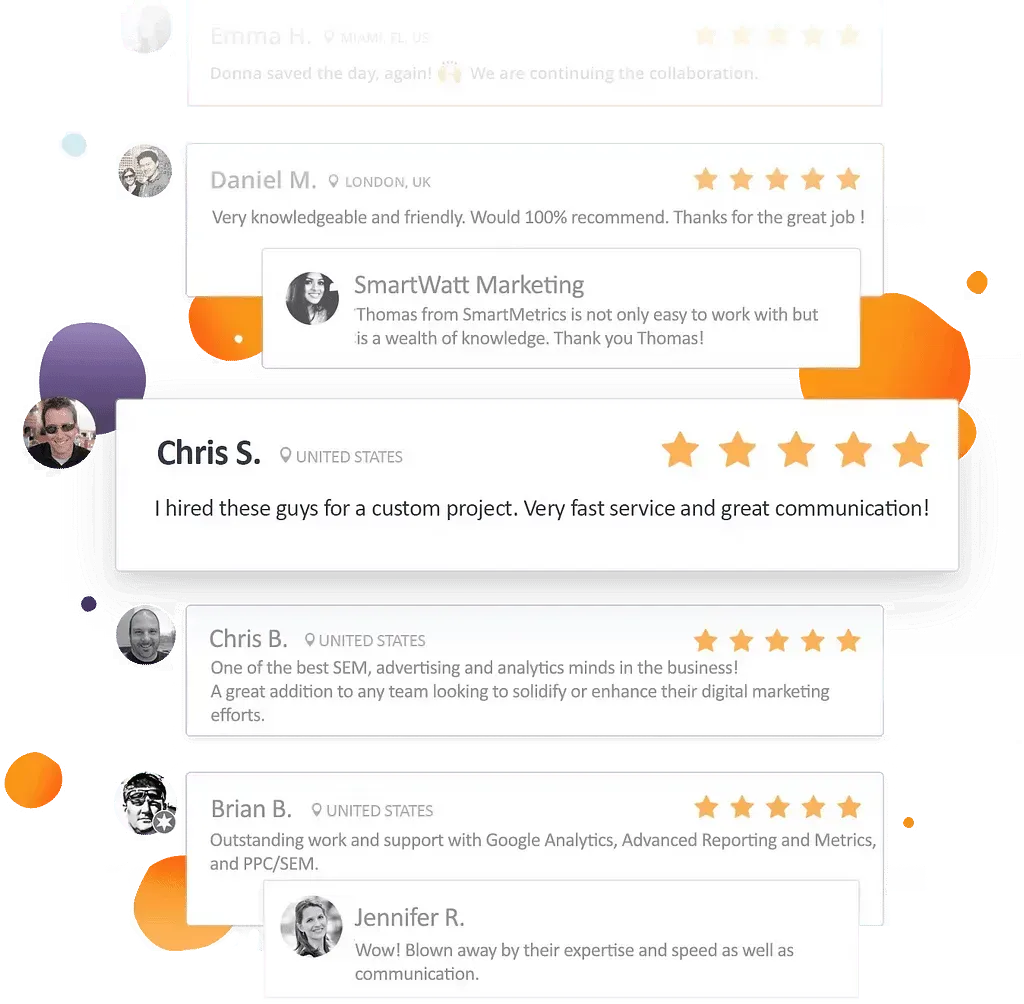 5.0 on Google · All reviews
“A huge difference to the business, and we know where the next dollar goes.”
 Blitzy
“We can scale spend now without guessing what is actually working.”
 PermitFlow
“Extremely knowledgable & capable!”
 Dj Haer Jr


Work with Tomas
Founder, San Diego, CA
20 years in marketing, CRO, CRM, and analytics. Now building the systems AI runs on.
You work with me directly, from scope to delivery. No account managers.