

Shopify Tracking and Analytics Setup
Shopify's built-in analytics won't tell you what's actually driving revenue
Shopify gives you orders and revenue totals. That's about where the useful data ends. It doesn't tell you which campaigns are profitable after ad spend. It doesn't show you where customers drop out of the product and checkout flow. It doesn't connect what someone did on your client's site to where they came from, what they looked at, and why they converted.
The deeper problem is that most Shopify stores are running on broken tracking and don't know it. Meta's pixel misses a significant share of purchases because of ad blockers and browser restrictions. GA4 ecommerce events are firing incorrectly or are incomplete. Google Ads optimizes on reported conversions that don't reflect real sales. When a client asks why ROAS dropped, nobody has clean enough data to give a real answer.
We first fix the tracking foundation, then build reporting on top of it. The result is a setup in which the data coming from every platform is trustworthy.
What we set up for you
GA4 Ecommerce Tracking
Shopify's default GA4 integration sends basic events but misses details and frequently misfires on checkout steps. We implement full GA4 ecommerce tracking: product list views, product detail views, add to cart, begin checkout, add payment info, purchase, and refunds. Every event includes the item data GA4 needs to run product performance reports, revenue attribution, and funnel analysis.
We also configure custom events specific to Shopify behavior: collection page browsing, search queries before purchase, cart abandonment points, and upsell interactions. When the tracking is right, GA4 becomes a genuinely useful window into how the store performs, not just a traffic counter.
Meta Pixel and Conversions API
Running Meta ads on pixel-only tracking means the algorithm is working with a fraction of the conversion data it needs. Ad blockers, iOS restrictions, and browser privacy settings all cut into what the pixel can see. We implement Meta's Conversions API alongside the pixel so purchase events, add-to-carts, and checkout initiations get sent server-side regardless of what the browser does.
Events get deduplicated properly so Meta sees accurate volume without inflated numbers. Better signal means better optimization, and ad spend that goes where it should.
Google Ads Conversion Tracking and Enhanced Conversions
Standard Google Ads conversion tracking loses accuracy the same way Meta does. We set up enhanced conversions, which pass hashed first-party customer data back to Google to match conversions the tag alone would miss. When combined with server-side tracking, your client's Google Ads account gains a much more accurate view of which campaigns and keywords are generating real revenue.
Where it makes sense, we also configure value-based bidding so Google's algorithm optimizes toward revenue rather than just conversion volume.
Server-Side Tracking via GTM and Stape
Browser-based tags are the weak link in any Shopify tracking setup. We move core event collection to the server side using Google Tag Manager hosted on Stape, so conversion events leave your server and reach ad platforms directly. Ad blockers don't affect it. ITP doesn't shorten attribution windows. Tracking runs reliably regardless of what happens in the customer's browser.
This infrastructure is what makes everything else accurate. Client-side fixes alone only get you so far.
TikTok and Snapchat Events API
If your clients run TikTok or Snapchat campaigns, the same tracking gaps apply. We implement both platform pixels and their server-side event APIs through the GTM container, so purchase data reaches each platform's algorithm with the same accuracy as it does for Meta and Google. TikTok heavily optimizes for purchase signals, and missing conversions directly hurt campaign performance.
Advanced Product Analytics
Beyond ad platform tracking, we implement PostHog or GA4 product analytics built specifically for e-commerce behavior. Funnel analysis across the full purchase path from landing page to order confirmation. Collection and product page performance. Search behavior and what customers look for before buying. Cart abandonment analysis showing where people leave. Cohort analysis showing which acquisition channels bring customers who actually return.
Session recordings tie into this directly. When conversion rates drop or a product underperforms, you can watch real user sessions on the affected pages and see what's actually happening instead of guessing.
Looker Studio Ecommerce Dashboards
We build Looker Studio dashboards that bring all data sources together in one place. Revenue and orders over time with period comparisons. Channel attribution showing which sources drive revenue, not just traffic. Product performance by top sellers, conversion rate, and collection. ROAS by channel and campaign. Customer acquisition cost is tracked over time.
The cross-channel view is where everything connects. A client opens a report and sees total ad spend across Google, Meta, TikTok, and other active channels, revenue attributed to each channel, blended ROAS, and where their budget is working. Scheduled email delivery means the report lands in their inbox on whatever cadence they want without anyone on your team manually sending it.
ROAS and Revenue Attribution
ROAS is only as useful as the data behind it. When tracking is incomplete, reported ROAS is optimistic, and clients make budget decisions based on numbers that don't reflect what's actually happening.
We set up ROAS reporting that accounts for ad spend from every platform, matches revenue to sessions using proper attribution windows, blends ROAS across channels, and includes product-level data when the client can provide margin information. When someone asks whether their ad spend is working, the answer is grounded in accurate numbers.
For stores on Shopify Plus, we also track wholesale orders, subscription revenue, and multi-channel sales as separate streams so reporting reflects how the business actually operates.
What changes when the tracking is right
Agencies with accurate Shopify tracking have better client conversations. Budget recommendations are defensible when the data is clean. The case for increasing spend on a profitable channel is easy to make when attribution is clear. CRO recommendations carry weight when product analytics show exactly where customers drop off.
E-commerce clients know the experience of spending more on ads and seeing returns that don't add up. Broken tracking is usually the reason. Fixing it doesn't just improve reporting. It changes what ad platforms can do with the data, thereby improving performance on its own.
We handle the full setup
Correct Shopify tracking involves GTM configuration, server-side container setup, API connections, GA4 event schema design, Looker Studio data blending, and cross-platform deduplication. Each piece affects the others, and getting it right the first time is faster and cheaper than debugging a broken setup six months later.
SmartMetrics handles implementation end-to-end. If you're already using us for client reporting or portals, Shopify analytics plugs directly into your existing setup. If not, this works as a standalone engagement.
What clients say
“Thomas is a certified expert. Not only did he help set up all the Google and Facebook analytic tags/pixels, he was also very helpful in walking us through how to use them. He is very knowledgeable and friendly. Would 100% recommend him. Thanks for the great job Thomas!”
Bryce Alsten
“Working with SmartMetrics has made a huge difference in my business. I now know what is working on an hour by hour basis, and where to invest additional resources. I can’t recommend it highly enough.”
Brian Elliott
“Outstanding work and support with Google Analytics, Advanced Reporting and Metrics, and PPC/SEM. We have an ongoing relationship with SmartMetrics and have never been disappointed. Will continue to work with Thomas and team!”
Brian Bigda
What clients say
“Tomas at SmartMetrics has been fantastic to work with. He consistently delivers high-quality work quickly, communicates clearly and proactively, and makes even complex implementations feel straightforward.”
 Gray Digital Group
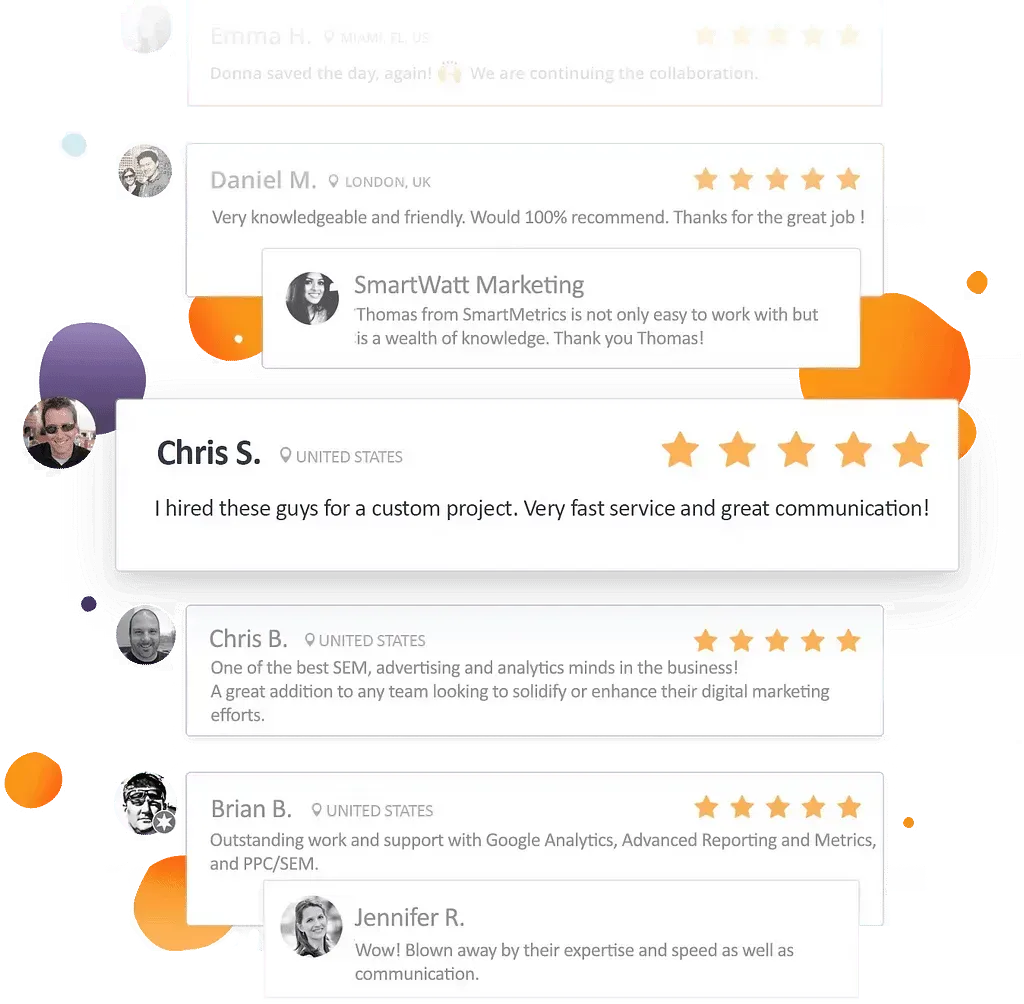 5.0 on Google · All reviews
“A huge difference to the business, and we know where the next dollar goes.”
 Blitzy
“We can scale spend now without guessing what is actually working.”
 PermitFlow
“Extremely knowledgable & capable!”
 Dj Haer Jr


Work with Tomas
Founder, San Diego, CA
20 years in marketing, CRO, CRM, and analytics. Now building the systems AI runs on.
You work with me directly, from scope to delivery. No account managers.